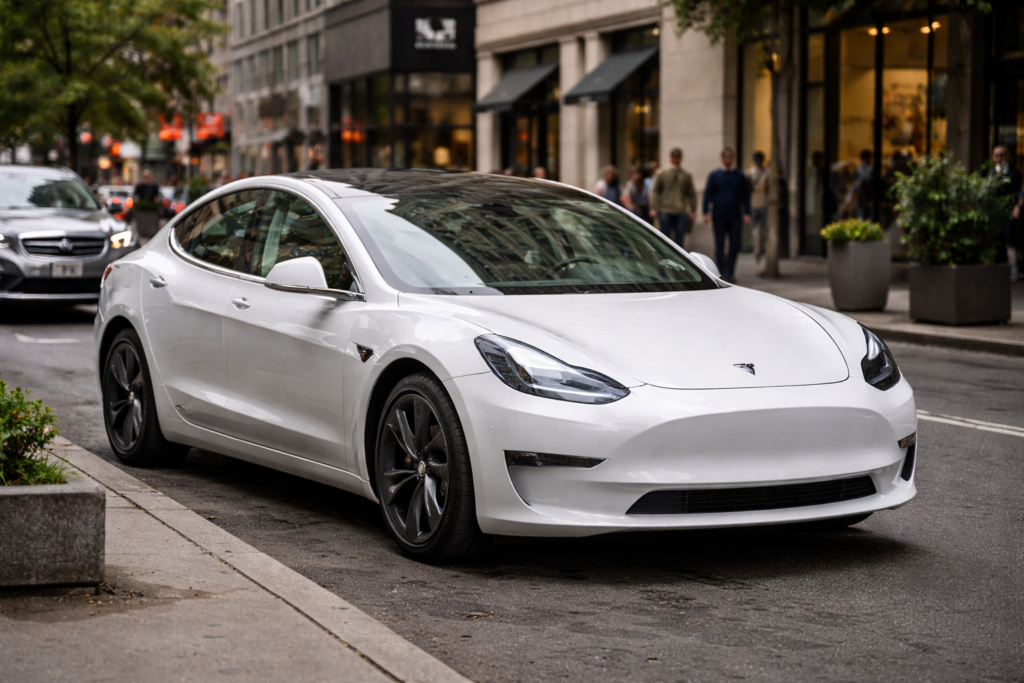
Tesla stock (NASDAQ: TSLA) has lost roughly 30% this year, leaving investors to decide whether the company’s emerging artificial-intelligence businesses can justify a valuation far above what its automotive profits currently support.
The stock closed Monday, July 27, at $309.22 after another 1.2% decline.
A $600 target would imply about 94% upside, meaning Tesla would need to almost double from its latest completed-session price.
That target is not a fresh response to Tesla’s second-quarter results. Then-Wedbush analyst Dan Ives established it in 2025 and maintained the bullish benchmark into 2026.
The latest earnings have made his argument considerably harder to prove. That shift has left the traditional car business carrying more financial weight.
The $600 target values Tesla as an AI company
Ives’ thesis rests on Tesla becoming more than an electric-vehicle manufacturer.
When raising his target, he wrote that the company was “taking major steps in advancing its AI Revolution path”, with autonomy and robotics at the centre.
The valuation case assigns substantial future value to robotaxi services, Full Self-Driving subscriptions and the Optimus humanoid robot.
Those businesses could theoretically produce higher margins and recurring revenue while expanding Tesla’s addressable market beyond vehicle sales.
However, at $309, the market is showing greater scepticism about when that promise will become meaningful cash flow.
Reaching $600 would require clearer evidence that Tesla can deploy unsupervised robotaxis at scale, increase paid software adoption and establish a credible commercial path for Optimus.
The target remains possible only under a successful AI scenario.
Analyst price objectives are projections, not guaranteed outcomes, and Tesla’s history of delayed product timelines makes execution central to any valuation built on distant earnings.
Tesla’s investment surge raises the cost of waiting
Tesla reported second-quarter revenue of $28.24 billion, up 26% from a year earlier, but adjusted earnings of 33 cents a share missed expectations.
Operating margin narrowed to 1.4%, highlighting the weakness beneath record vehicle deliveries.
Capital expenditure climbed to $5.8 billion as Tesla invested in AI computing, robotaxis, batteries and robot production.
Free cash flow turned negative by $1.1 billion, its first quarterly cash burn in more than two years.
“As capex more than doubles and free cash flow turns negative, investors are increasingly focused” on whether the spending strengthens Tesla’s physical-AI advantage, Morgan Stanley analysts led by Andrew Percoco wrote before earnings.
Heavy investment is not automatically bearish if it produces profitable businesses.
The difficulty is that investors still have limited information about robotaxi economics, Optimus costs and the timetable for material AI revenue.
Tesla expects annual capital expenditure to exceed $25 billion in 2026 and remain elevated.
That increases the risk of further cash burn before emerging businesses contribute enough income to offset their development and infrastructure costs.
The post Tesla stock is down 30% in 2026: can its AI dream still justify $600 price target? appeared first on Invezz